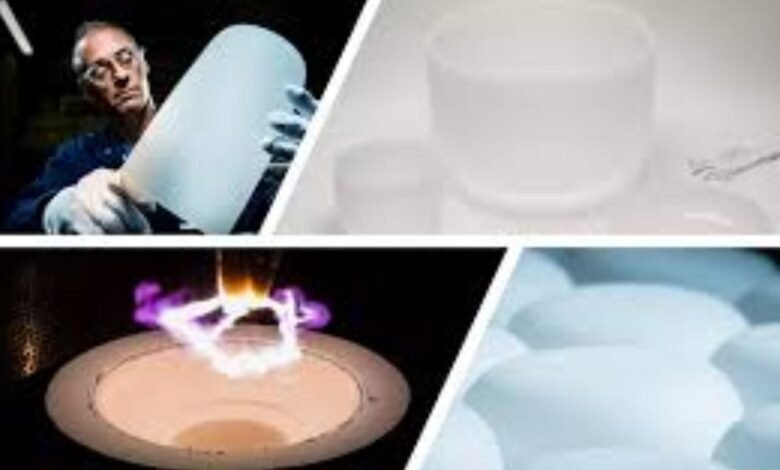
Fused quartz crucibles are essential tools in materials science, offering unmatched thermal stability, chemical resistance, and mechanical strength. Their unique properties make them ideal for high-temperature experiments, precision melting, and the handling of reactive substances. Researchers, engineers, and laboratory technicians rely on fused quartz crucibles to maintain experimental integrity and ensure accurate results in a wide range of applications.
Materials science often involves working with extreme temperatures, corrosive chemicals, and highly reactive substances. Standard crucibles may degrade or react under these conditions, compromising experiments. Fused quartz crucibles, composed of high-purity silica, withstand temperatures exceeding 1,600 degrees Celsius while maintaining chemical inertness. This combination of durability and stability allows scientists to perform experiments with precision, making fused quartz crucibles a cornerstone of modern materials research.
High-Temperature Melting and Processing
One of the primary applications of fused quartz crucibles in materials science is high-temperature melting and processing. These crucibles are used to melt metals, alloys, and glass with minimal contamination. Unlike metal crucibles, fused quartz does not introduce impurities, preserving the chemical composition of the material being processed.
In experimental research, maintaining purity is crucial. For instance, when developing new metal alloys or high-purity glass, even trace contamination can affect material properties and experimental outcomes. Fused quartz crucibles provide a stable environment that supports controlled melting, homogenization, and casting, ensuring consistent results. This capability makes them indispensable in laboratories focused on advanced material development.
Chemical Resistance and Inertness
Fused quartz crucibles are highly resistant to chemical attack, which broadens their applications in materials science. Many experiments involve strong acids, alkalis, or reactive gases that would corrode or compromise conventional crucibles. The chemical inertness of fused quartz prevents unwanted reactions, allowing researchers to conduct experiments safely and accurately.
For example, in the study of high-temperature ceramics or refractory materials, researchers often expose substances to aggressive chemical environments. Fused quartz crucibles maintain their integrity under these conditions, ensuring that experimental results reflect the material properties rather than contamination from the container. This resistance to chemical interaction is a defining feature of fused quartz crucibles and a critical factor in experimental reliability.
Thermal Shock Resistance and Precision Heating
Another significant advantage of fused quartz crucibles is their exceptional thermal shock resistance. Rapid temperature changes, common in materials science experiments, can cause many containers to crack or shatter. Fused quartz crucibles withstand sudden heating or cooling without compromising structural integrity, making them ideal for processes that require precise temperature control.
This property is particularly important in applications such as thermal analysis, sintering, and the preparation of high-performance ceramics. Researchers can heat and cool materials rapidly, observe phase changes, and conduct repeated cycles without worrying about crucible failure. The combination of thermal stability and shock resistance enhances experimental flexibility, allowing scientists to explore new processes and material behaviors confidently.
Applications in Semiconductor and Optical Materials
Fused quartz crucibles play a vital role in the production of semiconductor and optical materials. The electronics industry demands materials of the highest purity, where even minute impurities can disrupt performance. Fused quartz crucibles provide the contamination-free environment necessary for melting and processing silicon, gallium arsenide, and other semiconductor compounds.
In optical material research, fused quartz crucibles are used to create high-quality glass and lenses. Their ability to withstand extreme temperatures without introducing defects or impurities ensures that optical properties, such as transparency and refractive index, remain consistent. These applications highlight the importance of fused quartz crucibles in cutting-edge technological research and industrial processes.
Laboratory Research and Experimental Studies
Beyond industrial applications, fused quartz crucibles are widely used in laboratory research for experimental studies in materials science. They are suitable for thermal analysis, spectroscopy, and chemical synthesis where purity, temperature stability, and chemical resistance are critical.
In experimental setups, fused quartz crucibles enable precise measurements and reliable replication of results. Researchers can conduct experiments involving molten salts, refractory materials, and advanced ceramics without concern for contamination or material degradation. This reliability makes fused quartz crucibles a preferred choice for academic research and experimental development in materials science.
The versatility of fused quartz crucibles extends to interdisciplinary research as well. They are used in chemistry, physics, and engineering laboratories for studies that require high-temperature, chemically inert containers. Their widespread adoption across multiple scientific fields underscores their critical role in advancing experimental techniques and material understanding.
The longevity of fused quartz crucibles further enhances their value. Unlike metal or ceramic crucibles that may degrade over time, fused quartz maintains structural and chemical integrity through repeated high-temperature cycles. This durability reduces replacement costs, provides consistency across experiments, and supports long-term research programs.
By combining high thermal stability, chemical resistance, and mechanical strength, fused quartz crucibles serve as an essential tool in modern materials science. Their applications span high-temperature processing, semiconductor manufacturing, optical material preparation, and laboratory research. For scientists and engineers, these crucibles provide a reliable foundation for experiments requiring precision, purity, and durability.
The use of fused quartz crucibles in materials science is indispensable. Their unique properties enable researchers to explore new materials, develop high-purity products, and conduct experiments with confidence. From melting and processing metals to producing optical materials and supporting laboratory studies, fused quartz crucibles continue to play a vital role in scientific advancement, innovation, and the development of next-generation materials.